Severn City Airport closes and strands its passengers
Station ElevenThe closure of Severn City Airport turns a temporary diversion into a forced settlement. As the Georgia Flu pandemic reaches North America, the airport’s passengers learn that commercial flight has stopped and roads are impassable. Some leave on foot; others, including Clark Thompson, remain. What begins in confusion and uncertainty becomes a community that endures for decades, measures its years from the catastrophe, and eventually makes the airport itself a home and a repository of the past.
The Last Flights and the Closure
Clark reaches the airport on a flight diverted from Toronto, one of the last twenty-seven planes to leave John F. Kennedy International Airport. He has avoided infected people and contaminated surfaces by chance, unaware of the scale of the outbreak while travelling. Elizabeth Colton and her son, Tyler Leander, are on the same flight. Clark had previously told Elizabeth his travel plans, and she had said she would try to join him; she and Tyler sit in First Class while he travels in Economy. They exchange greetings, then do not speak again until the aircraft is diverted and the passengers disembark at Severn City Airport.
The terminal first looks like a place where normal travel has merely been interrupted. Clark sees crowds gathered beneath television monitors and buys tea before joining them. The news reports the pandemic’s arrival in North America: delayed evacuations, unrest outside hospitals on three continents, and roads filled with people trying to leave cities. A final plane, an Air Gradia jet, lands but turns away from the terminal and parks at a distance. No ground crew goes to meet it. Its isolation becomes a visible sign that the airport’s ordinary traffic has stopped, though passengers do not yet fully understand what that means.
The announcement makes the break official. For public-health reasons, the airport is closing immediately; there will be no flights for the indefinite future. Passengers are told to collect their bags, leave in an orderly fashion, and remain calm. Anger follows, directed at airport management, the airlines, the Transportation Security Administration, and phones that no longer help. Beneath it is the still-ungrasped possibility that the news represents not a temporary emergency but the end of the systems on which travel depends.
A Terminal Without an Exit
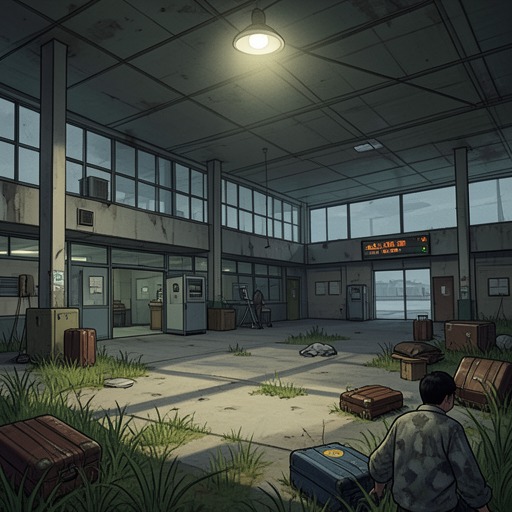
Airport workers close the restaurants and shops, lower steel shutters and gates, and leave. Passengers begin streaming out of the concourses. Elizabeth and Tyler emerge from the Skymiles Lounge, but Elizabeth does not know where they could go: roads are blocked by abandoned cars, airlines have shut down, and trains and buses are unavailable. Clark decides to stay for the moment. Some passengers who initially leave return after finding no ground transportation; others set out on foot toward Severn City. No airport official arrives to remove the roughly hundred people who remain.
The shutdown is not simply the loss of a plane journey. The terminal’s departing passengers are caught between a functioning institution that has issued instructions and a world in which those instructions no longer provide a viable route away. The Air Gradia agent weeps at the ticket counter while the display overhead continues to announce that Flight 452 is arriving. Clark hears the word quarantine over her radio. The flight’s distant position, the still-lit arrivals display, and the emptying shops register different stages of a transport network becoming unusable: the signs remain, but the service they promise has ended.
Some remaining passengers cover their mouths and noses with scarves or T-shirts. Many are foreign travellers who look out at the international aircraft parked end to end on the tarmac. The planes, once instruments of rapid movement across borders, cannot carry them onward. Elsewhere, the same breakdown forces people onto slower and less reliable routes. In Toronto, Kirsten Raymonde and Peter Raymonde escape by car, but abandoned vehicles clog the expressway ramps and side roads, so they continue on foot. Jeevan Chaudhary chooses to follow the lakeshore rather than the roads, hoping to avoid other people. These journeys sharpen the airport passengers’ predicament: movement is still possible, but the infrastructure that once made it routine has failed, and every alternative carries new risks.
From Temporary Refuge to Home
The stranded passengers initially count time as if rescue and a return to normal travel remain imminent. They expect the National Guard to arrive with blankets and food, then airport crews to resume operations. The count advances from Day One and Day Two to Day Forty-eight and Day Ninety. When the anticipated return never comes, that calendar loses its meaning. The survivors later resume naming days and months in the familiar way, but retain a new system for years, measured from the disaster. By Year Four, Clark understands that this is how time will continue to be counted.
The airport’s perimeter becomes more than a place of waiting. After a scouting party encounters the silence beyond a roadblock and returns with carts of supplies, Dolores feels relief when the terminal comes back into view; she recognizes it as home. The party has passed abandoned cars and a quarantine warning, and avoided a nearby hotel because of what the darkened building seemed to contain. Their return makes the airport’s safety relative rather than absolute, but also shows how a group’s shared experience can change a public building into a place of belonging. Guards with whistles provide warning when strangers approach. The first man to arrive carrying a gun drops it when challenged, and his struggle to speak suggests how long he has been alone. The passengers’ feared image of dangerous wanderers gives way, in this encounter, to a stunned survivor seeking other people.
The airport’s population and purpose change over time. By the end of the second decade, most residents have either been born there or arrived later, but about two dozen people remain who landed on the first day. Clark’s flight had taxied to Concourse B among jets from Singapore Airlines, Cathay Pacific, Air Canada, Lufthansa, and Air France. The airport’s history is thus preserved in both memory and the aircraft still standing on its tarmac. Planes elsewhere in the post-collapse world become storage spaces for food, their wings gathering snow; here, too, the once-mobile fleet belongs to a changed landscape rather than a functioning system of departure.
Settlement, Memory, and the Museum
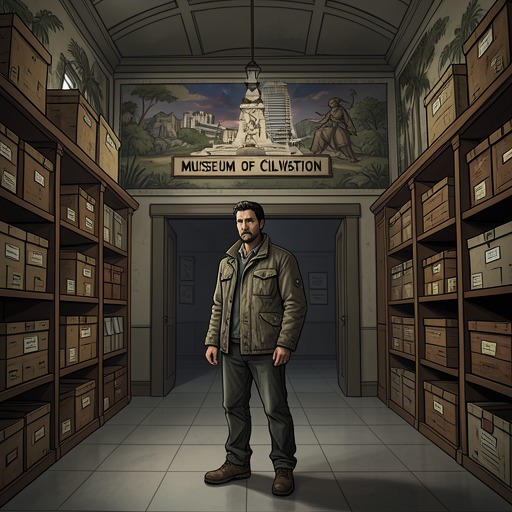
By the end of Year Fifteen, three hundred people live at the airport, and the Museum of Civilization fills the Skymiles Lounge. Clark had spent the earlier years on work essential to survival: gathering firewood, hauling water to keep restrooms usable, salvaging materials in Severn City, planting crops beside the runways, and skinning deer. As the community grows and he ages, he is able to devote his days to the museum. Its collection includes phones, tablets, laptops, Tyler’s Nintendo console, impractical shoes, cleaned car engines, and a chrome motorcycle. Traders bring him magazines, newspapers, stamps, and coins; Clark also carefully records passports, driving licences, and credit cards belonging to residents who have died.
The museum’s objects have little practical value in the settlement, yet people want them preserved. Their presence makes the airport’s long transformation legible: a place built to move people through becomes a home where they stay, and a collection where the tools and tokens of the former world acquire historical meaning. Clark keeps Elizabeth and Tyler’s passports open to their photograph pages. She gave them to him on the night before she and Tyler left, in the summer of Year Two, and he remains unsettled by them years later. Their photographs hold a particular absence within the larger archive.
The closure therefore does not resolve into a simple tale of rescue or escape. It divides travel into a before and an after, then forces a new social life to grow inside the abandoned infrastructure of the old one. Clark’s memories of planes that took off, and of the world’s once-unremarkable conveniences, persist alongside the practical labour that keeps the settlement alive. The terminal that first seemed to hold its passengers only temporarily becomes the ground on which a new calendar, community, and public memory are built.